
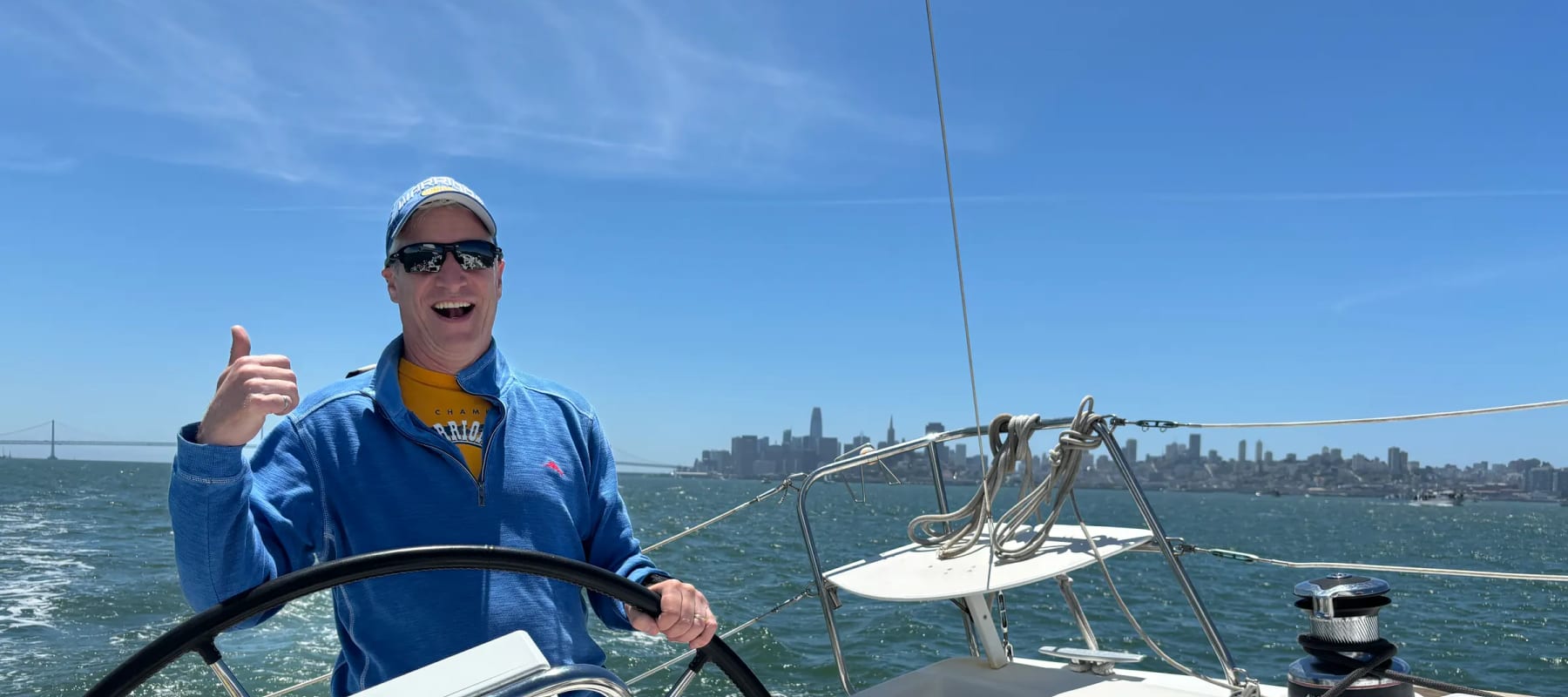
Every charter reaches the same moment. The sails are trimmed, the boat has settled into a rhythm, the skyline is sliding past, and the captain looks over and asks whether you want to drive.
Almost everyone says yes. Almost nobody knows what they are about to be handed. There are two entirely different ways to steer a sailboat, our fleet has both, and they feel nothing alike.
A tiller is a stick attached to the rudder
That is the whole mechanism. A tiller is an arm of wood or aluminum bolted to the top of the rudder post. You push it, the rudder turns, the boat turns. There is no cable, no gearing, no hydraulics, nothing at all between your hand and the water.
Which means the boat talks back. Every gust, every wave, every change in the way the sails are trimmed arrives in your palm as a push or a sudden lightness. Sailors call it load, and on a tiller boat you feel all of it.
The one thing that surprises everybody: a tiller steers backwards. Push it to the right and the boat turns left. Most people stop having to think about it within about ninety seconds, and after that it never bothers them again.
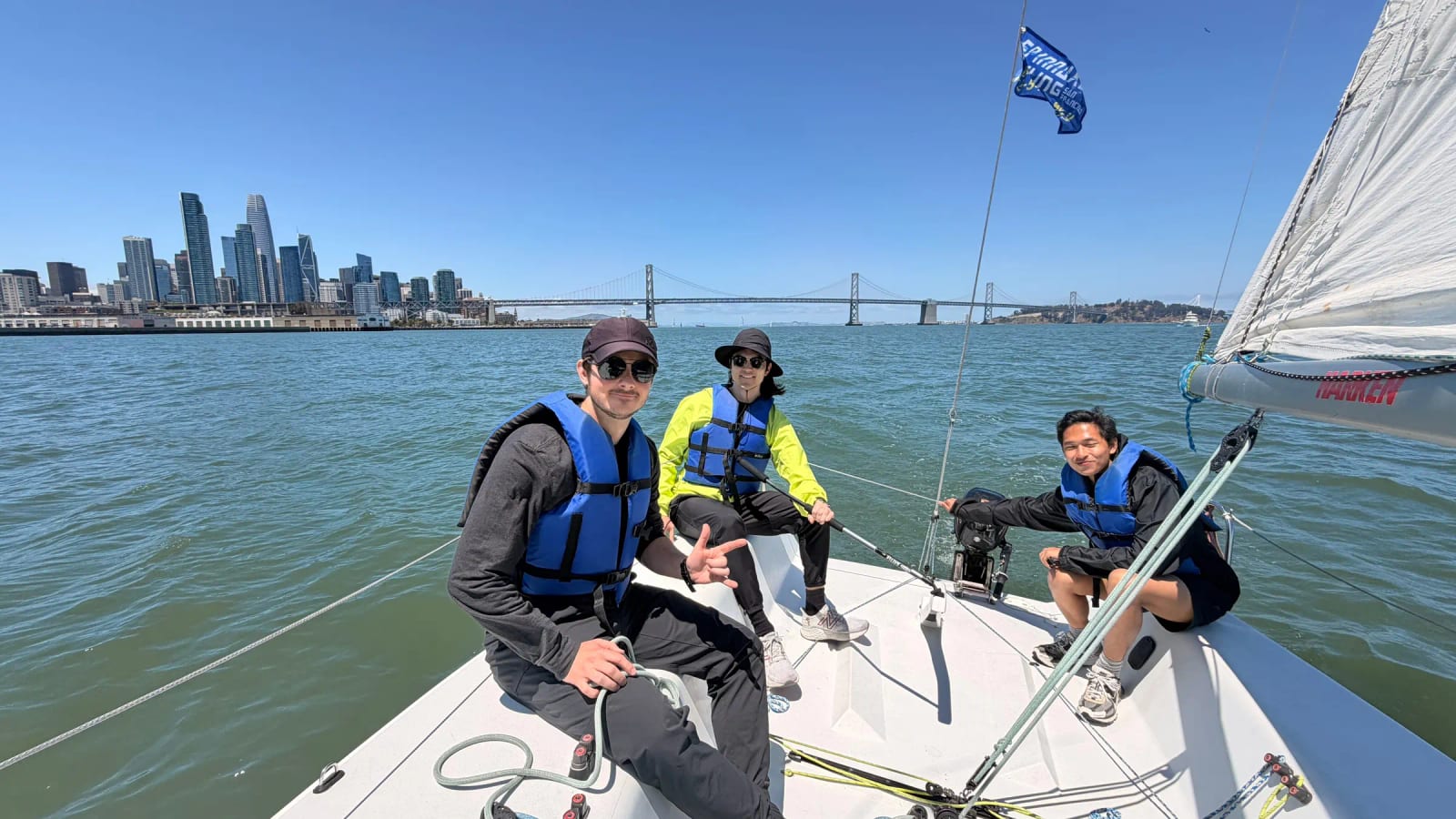
A wheel is the same idea with machinery in between
Go up in size and the rudder gets bigger, the loads get higher, and an arm you hold in one hand stops being practical. A wheel fixes that. Turn it and a system of cables, chains or gears turns the rudder for you, multiplying your effort the same way a winch multiplies a pull on a rope.
Two things change. The first is welcome: a wheel steers the way a car does. Turn it right and you go right. There is nothing to unlearn.
The second is the trade. Some of what the boat is telling you gets absorbed by the machinery before it reaches your hands, so you feel less of it. In exchange you can steer fifty feet of boat through twenty five knots of Bay breeze with two fingers, standing up, seeing over the cabin, for three hours, without your arm ever getting tired.
Which of our boats has which
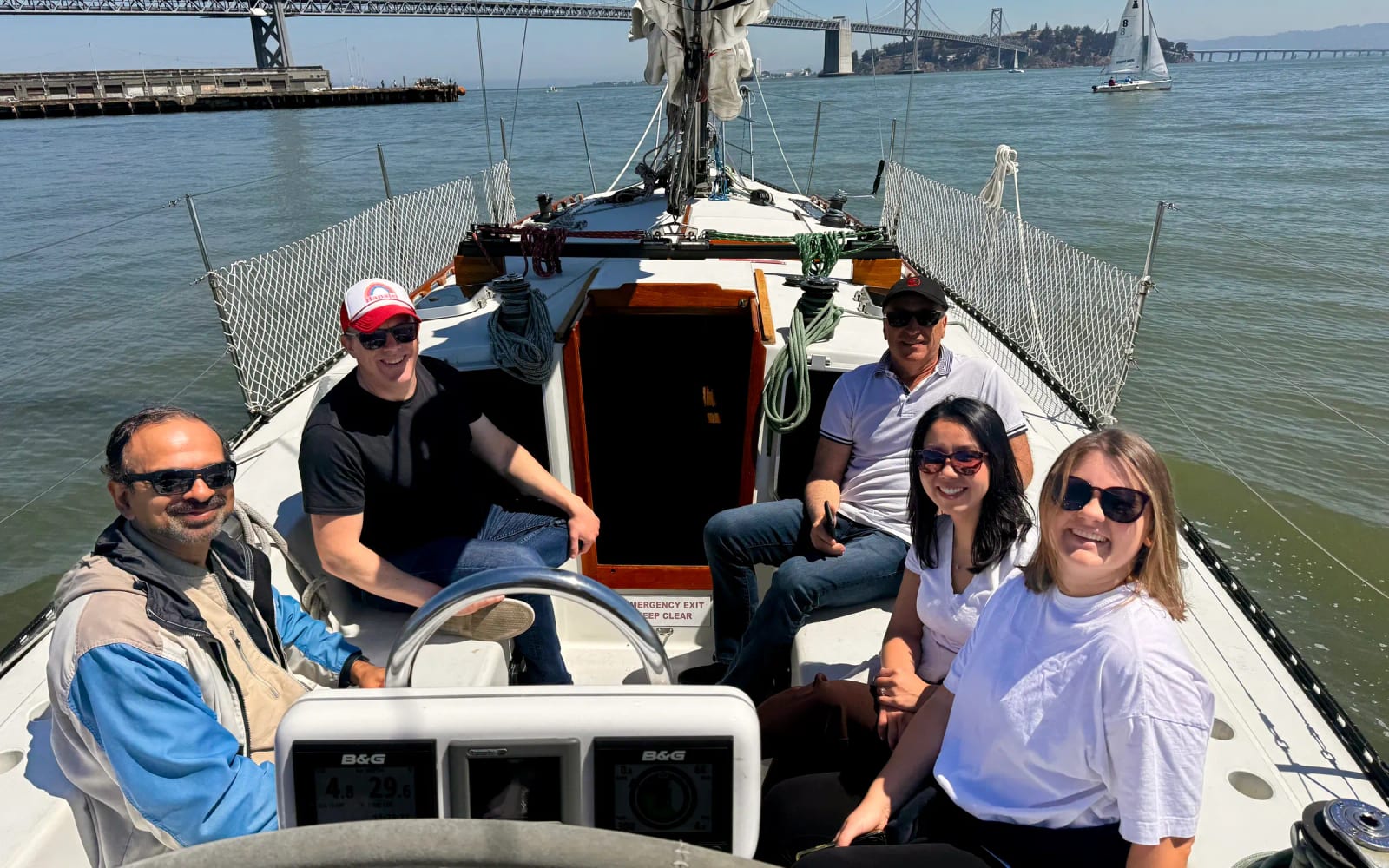
The short version is that the small boats have tillers and the big boats have wheels. The dividing line in our fleet falls somewhere around thirty five feet, and it is not arbitrary. That is roughly the size at which a rudder stops being something you can reasonably hold on to.
| Boat | Length | Steering | What it feels like |
|---|---|---|---|
| Andrews 21 | 21 ft | Tiller | The most direct boat we own. Every input shows up immediately, which is exactly why it is the one we race. |
| J/80 | 26 ft | Tiller | Light, quick and forgiving. A very good first tiller for someone who has never steered anything. |
| Cora | 30 ft | Wheel | The gentlest introduction to a wheel. Steady, unhurried, and hard to get wrong. |
| Wonder & Racer-X | 35 ft | Tiller | The largest tiller boats we run, and the most rewarding. Race boats, steered like race boats. |
| J/109 | 36 ft | Wheel | Quick for its size and still light on the helm. A performance boat that anyone can drive. |
| Valkyrie | 37 ft | Wheel | Comfortable and stable. The wheel is big enough to steer from either side of the cockpit. |
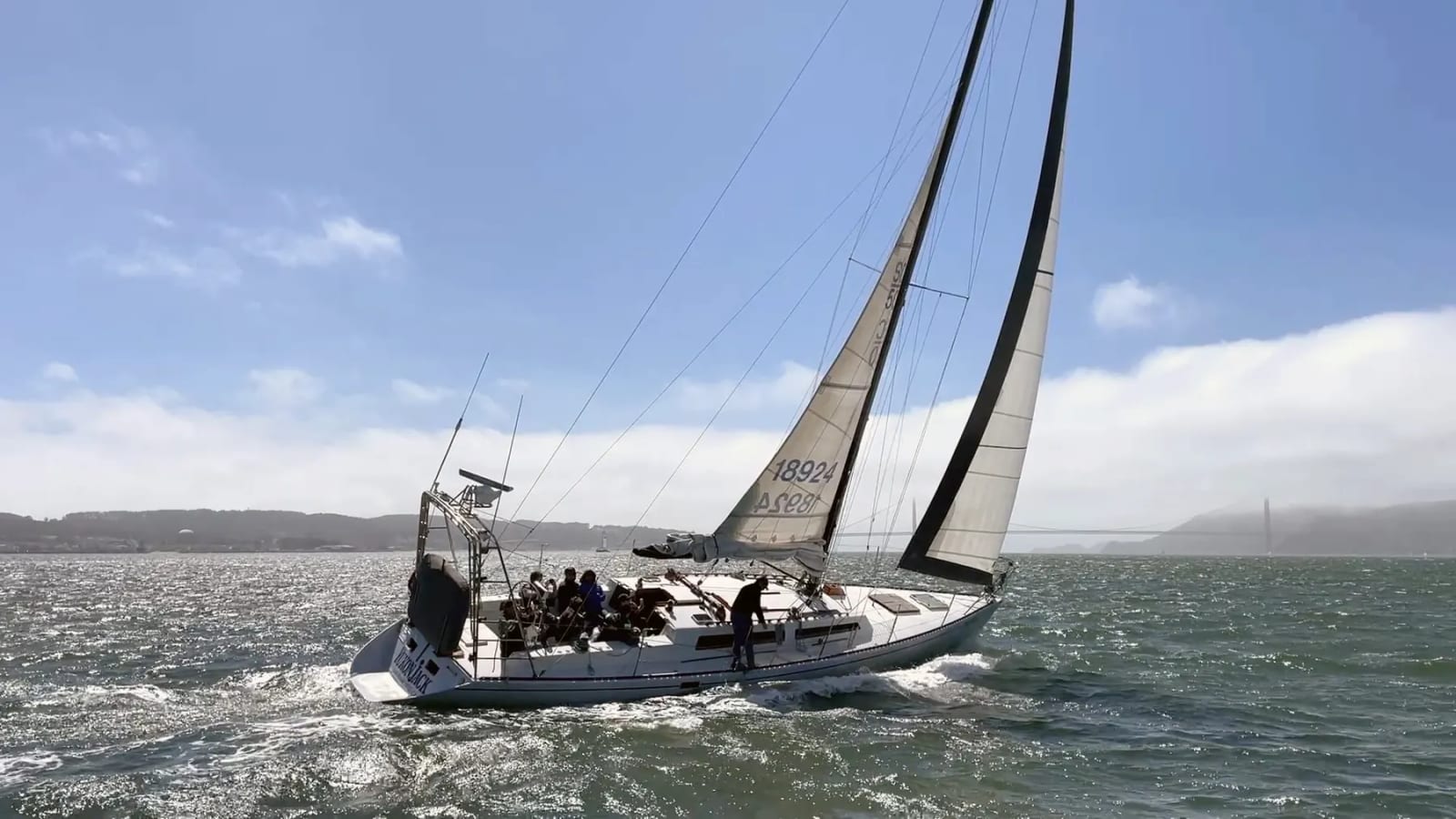
| Yukon Jack | 50 ft | Wheel | Fifty feet of boat that steers with two fingers. The most surprising helm in the fleet. |
The J/105s are the interesting case. At thirty five feet they are the largest tiller boats we run, and that is the designer being deliberate rather than the boat being underbuilt. They are one design race boats, and a tiller is simply faster to work with when the crew is trimming for every shift.
So which should you ask for?
If you have never steered a sailboat, a wheel is the softer landing. It behaves the way you expect, you can stand behind it and see the whole boat, and getting it slightly wrong produces a slow and forgiving result.
If what you actually want is to understand what the boat is doing, ask for a tiller. Fifteen minutes on a tiller will teach you more about how a sailboat works than an hour on a wheel, for the simple reason that nothing is filtering it for you.
Sailors who have spent thirty years driving big boats still light up when someone hands them a tiller. It is the closest thing to holding the boat itself.
What we will actually ask you to do
Not much, and never on your own. The captain stays right beside you the entire time. In practice, steering a charter boat comes down to three things.
- Pick something and aim at it. A bridge tower, a headland, a building on the skyline. Steering at a landmark is far easier than steering to a compass, and it is what most of us do anyway.
- Move it less than you think. The universal beginner instinct is to correct hard and then correct back. Small inputs, held for a moment, work better on every boat we own.
- Watch the front edge of the sail. If it starts to flutter you have turned too far toward the wind. Come back a few degrees and it settles down.
That is genuinely the whole job. People who have never touched a boat are steering competently within a couple of minutes, which is less a compliment than a fact about sailboats: under sail a boat mostly wants to go in a straight line, and your real task is to avoid interfering with it.
One last thing
You are allowed to say no. Plenty of guests would rather sit on the high side with a drink and watch the city go past, and that is a completely legitimate way to spend an afternoon on the Bay. Nobody is going to hand you anything you did not ask for.
But if you have ever quietly wondered whether you would be any good at it, the answer is almost certainly yes. The moment to find out is about forty minutes into a three hour charter, somewhere off Alcatraz, with the afternoon westerly properly filled in.
Have a look at what each boat is like across the fleet, or ask us about a charter and mention that you want a turn at the helm. We will make sure you get one.