
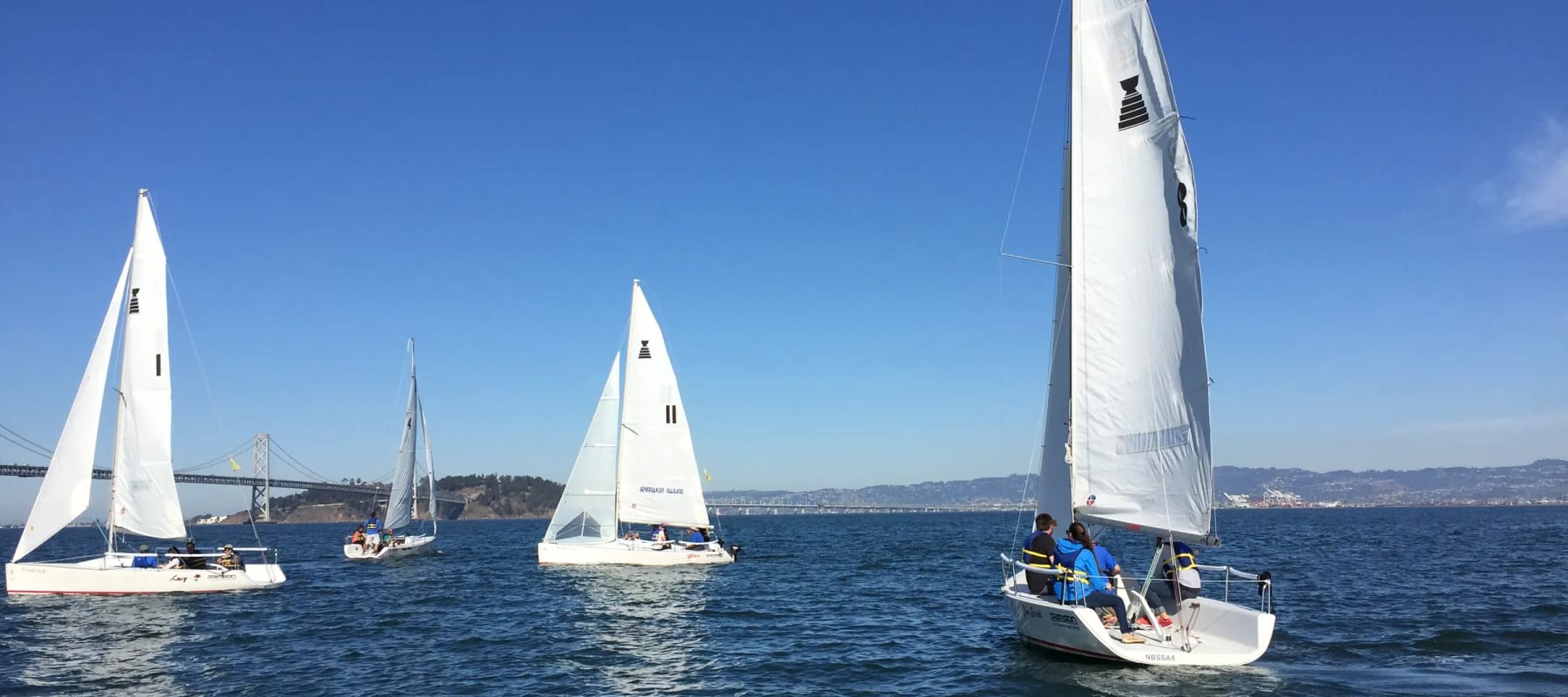
It happens on a lot of our charters. Somebody takes the helm for twenty minutes, hands it back, and then spends the rest of the afternoon quietly working out whether they could learn to do this themselves.
If that is you, the answer is yes, and the route is well marked. It is also, at first glance, baffling. ASA 101, 102, 103, 104, 105 is a wall of numbers that turns out not to run in numerical order, and only some of them get you onto a boat. Here is what each one actually is.
First, who teaches it
Rendezvous Charters does not run the courses. Spinnaker Sailing does, out of the same harbor at Pier 40, and the two operations share boats and crew. That is worth knowing for a practical reason: the boat you get certified on is very likely a boat you have already sailed on with us.
The numbers are not the order
This is the part that confuses everybody, so it is worth stating plainly before anything else. You take 101, then 103, then 102, then 105, then 104. The numbers describe what each certification covers. They say nothing about the sequence you earn them in.
| Order | Course | What it covers | What it unlocks |
|---|---|---|---|
| 1st | Basic Keelboat 1 & 2, giving ASA 101 | Sailing, motoring and docking, taught on the Bay | Nothing yet. It is the prerequisite for ASA 103. |
| 2nd | ASA 103, Basic Coastal Cruising | Anchoring, heavy weather, trip planning, man overboard, downwind technique, check-in and check-out | Chartering the Andrews 21s. |
| 3rd | ASA 102, Sportboat | Sail trim, close-quarters handling, and making a boat go efficiently rather than just correctly | The J/80. |
| 4th | High Wind Endorsement | Not an ASA course. A Spinnaker requirement for the windier half of the Bay. | Sailing north of the Bay Bridge. |
| 5th | ASA 105, Coastal Navigation | Chart reading, plotting courses, navigation fundamentals. Self-paced and self-study. | No boat on its own. It is the prerequisite for ASA 104. |
| 6th | ASA 104, Bareboat Cruising | Usually a multi-day trip: anchoring, watch schedules, provisioning, and planning a route properly | Boats 35 feet and up, and eligibility for an International Certificate of Competency. |
Where everyone starts
Basic Keelboat 1 and 2 is the foundation, and it is genuinely the fundamentals: making the boat go, working the engine, and getting alongside a dock without incident. You come out of it holding ASA 101.
On its own it unlocks nothing, which surprises people. Think of it less as a permission slip and more as the thing every later course assumes you already have.
The first one that gets you a boat
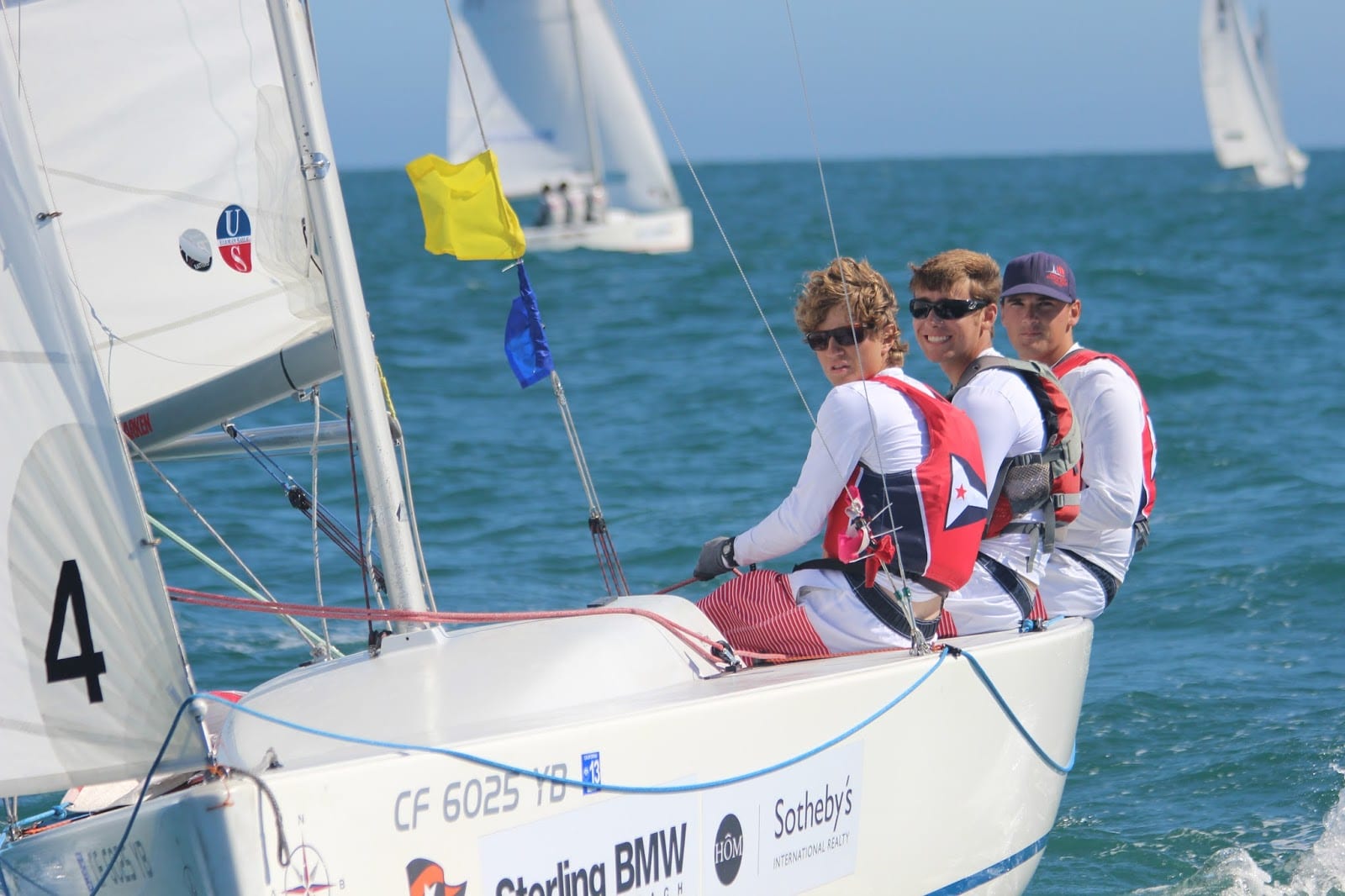
ASA 103, Basic Coastal Cruising, is where you start sailing bigger and further out. It covers anchoring, heavy weather, man overboard drills, downwind technique, and the unglamorous but essential business of checking a boat out and back in again.
Finish it and you can charter the Andrews 21s yourself. For most people this is the moment the whole thing stops being theoretical.
Then a detour into going fast
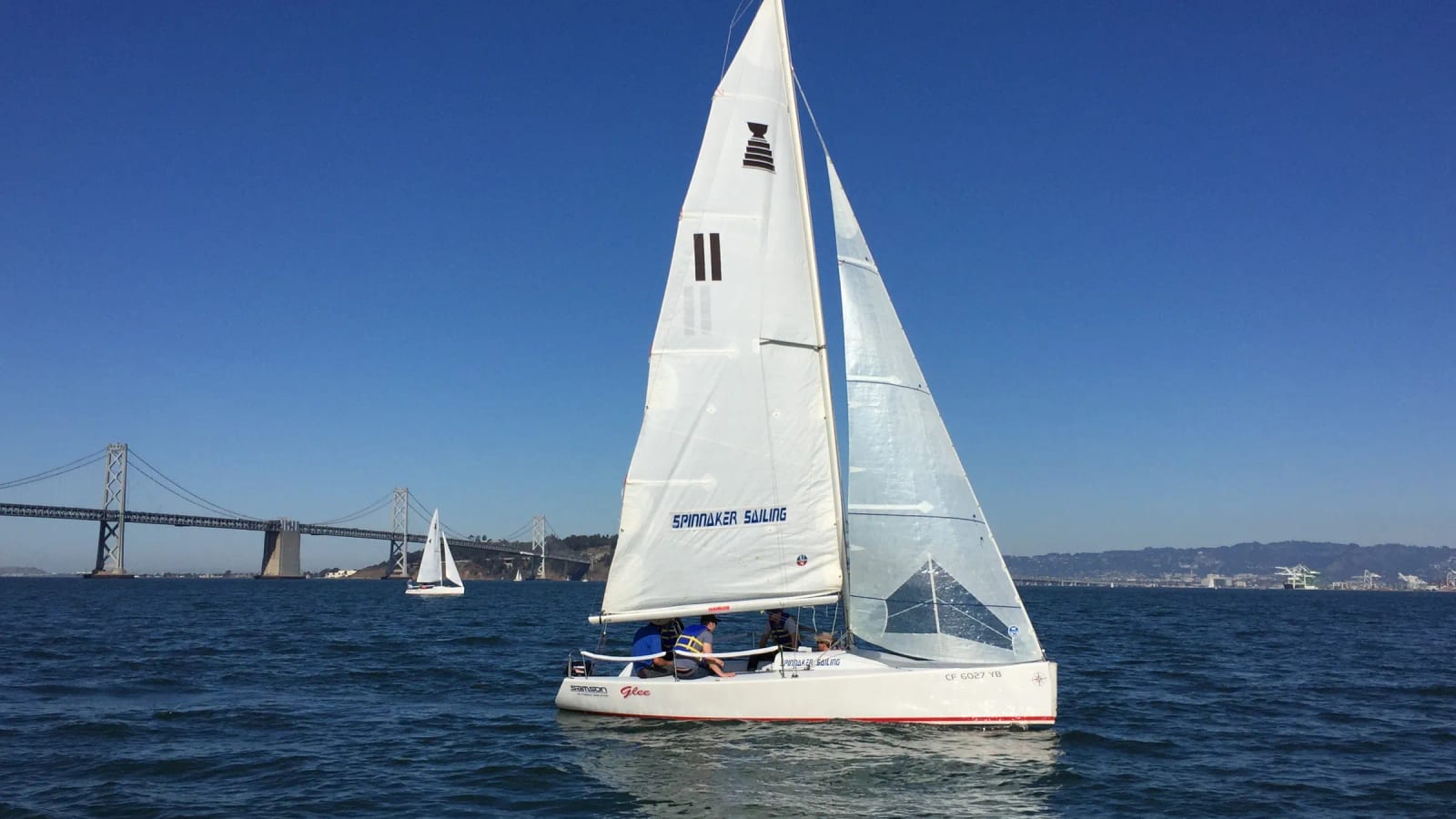
ASA 102 is the Sportboat certification, taught aboard the J/80. Where 103 is about handling a boat responsibly, 102 is about handling one well: trim, close-quarters maneuvering, and the difference between a boat that is being sailed correctly and one that is being sailed properly.
It unlocks the J/80 specifically. It is also, by most accounts, the most fun course on the path.
The step that is not an ASA course at all
The High Wind Endorsement is Spinnaker's own requirement rather than an ASA certification, and it exists because of geography. North of the Bay Bridge the breeze builds fast and the water gets rougher, and the Bay does not ease you into it gradually.
Until you have it, you sail the calmer southern waters. It is not a formality, and it is the single clearest signal that the certifications here are built around this particular stretch of water rather than sailing in general.
Every course on this list is taught in the conditions you will actually sail in. That is slower than learning somewhere flat, and it is the reason people who learn here can sail anywhere.
Navigation, and then the big one
ASA 105, Coastal Navigation, is self-paced and self-study: charts, plotting, and the fundamentals of knowing where you are without being told. It unlocks no boat by itself, but nothing else opens without it.
ASA 104, Bareboat Cruising, is what most people are working toward without knowing its number when they start. It usually involves a multi-day trip with real anchoring, real watch schedules, and real planning, from provisioning through to the route itself.
It gives you boats 35 feet and up, which is effectively the whole fleet. It also makes you eligible to apply for an International Certificate of Competency, which is the document charter companies and insurers recognize outside the United States.

Questions we actually get asked
- Do the certifications expire? No. Once you have one it is yours for life, with no renewal. Coming back for a refresher after a long gap is still a good idea before you charter, but nobody will make you retake anything.
- Can I skip a level if I have sailed before? The steps are taken in order, because each course assumes the one before it. If you have real experience elsewhere, say so early. It usually means moving through the early levels faster rather than skipping them.
- How long does the whole path take? Anywhere from a few focused months to well over a year. There is no clock running, and most people take one course whenever it happens to suit them.
- Will ASA 104 work abroad? Yes. Combined with the International Certificate of Competency it is recognized by charter companies and insurers well beyond San Francisco Bay.
You do not need any of this to sail with us
Worth saying, because the numbers can make sailing look like a licensing regime. Every charter we run comes with a captain, and you are welcome to spend the entire afternoon with a drink in your hand and no responsibilities at all.
The path above is for the people who get off the boat still thinking about it. If that is you, start with the lessons at Spinnaker Sailing. If you would rather come back out with us first and take another turn at the helm before committing to anything, have a look at the fleet and tell us what you have in mind.